

Authors: Charlotte Felbacq
Cabaia: building your brand with a physical and digital strategy
Third #clubhouse, and summit meeting with Bastien Valensi, founder of Cabaia. Bastien has been the king of pompom for 6 years, after having worked for 7 years as a fabric salesman at C-MOD, having previously worked at HEC - la Haute École des Copains - after a stint in a “champion factory”, aka a preparatory class.
We talked about the brand's DNA, its pop-up development strategy and community. All with self-deprecation and humility.

Self-deprecation, one of Cabaia's weapons?
Cabaia's culture is based on self-deprecation. It is the DNA of the brand, and it is what seduces our customers and employees.
When I created Cabaia, I wanted to embark on an adventure. One of my greatest pride is the team that is being created. We are in exactly the same state of mind, we don't take ourselves seriously and we remain humble. In a photo, you don't look like much. Cabaia is the same. They don't see us coming, and we're never where we're expected to be.
We are a bit like the “Rasta Rockets” of retail, and that's reflected in our strategy. With the crisis, brands are leaning towards digital, there is a real aversion to the physical. We, in fact, are going into the physical world. This is how we are noticed, thanks to this spirit and this quirky culture.
We are not a fashion brand or a trendy brand that is likely to become has been after four years. We are a brand that speaks to the whole family and offers international lifestyle products. And it's this self-deprecation that makes it possible to talk to everyone. In addition, there is the choice of colors, trendy and striking with an innovative touch for each product.
Cabaia is growing with a target of 6 billion people with no distribution limits and no geographical area limits.
More than a DNVB, a PNVB (Pop-up Native Vertical Brand)?
We are neither one nor the other, only a brand that has observed its market before launching. Today, it's easy to set up your business, all you have to do is create a website. On the other hand, what is complicated is to stand out, especially in the digital world. What was complicated yesterday has become easy today, and vice versa. Without a brand identity, if a competitor enters the market with the same products but with more competitive prices, the customer chooses the competitor without hesitation.
The idea was to Bet on a real story to retain customers, and Create a physical connection. So I started the Cabaia adventure alone, by opening pop-up stores in shopping centers. The advantage with the pop-up store is that you get immediate feedback from customers, you know right away if it will work. If a brand focuses only on e-commerce, it takes about two years to understand and create a relationship with its customers. During these four months in a pop-up store, I was trying to understand who I was talking to, if it was going to work.
The pop-up, after all, is a communication campaign that costs you nothing, it's like a billboard on the subway. We didn't do it to make money, but to create an experience with the customer.
There are two important things when you Create a pop-up : the merchandising in which you will tell the story of the brand (for Cabaia, it had to be a happy organized mess) and the salesperson training. It's essential, it's your storefront and that's what makes your pop up work or not. The point is to have a good time, otherwise it's useless.
Digital or physical strategy?
Contrary to popular belief, Exponential growth and profitability do not go together when doing digital. Digital technology means colossal budgets. At the beginning, you can manage, but when you want to accelerate, it's expensive and requires specific skills. At Cabaia, we prioritized profitability, and therefore the physical.
I am sometimes asked how I financed my pop-ups. But finally, rent may seem more expensive but it is paid at the end of the month. During this time, we have the opportunity to make the operation profitable. Furniture, which is very important, can also be paid in installments, there are always solutions. Compared to a strategy built on Instagram or Facebook, the physical one costs less.
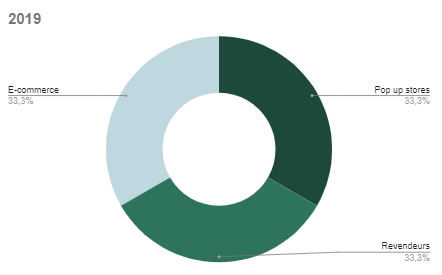
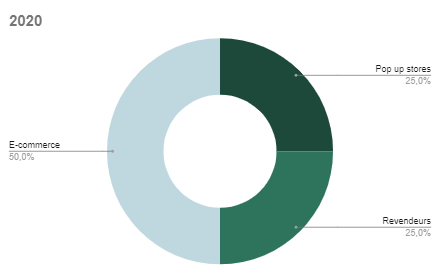
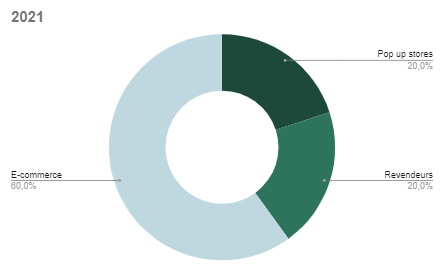
The pop-up store was therefore our first acquisition channel.. When the site was launched, the only customers who went there were those who had known the brand physically. And then little by little, the prices of locations in shopping centers increased. The financial balance was no longer as interesting, so it opened up to other distribution channels: e-commerce and retailers. At that moment, I really had the impression of managing three companies, it was a real challenge.
It is true that the reseller channel can be perceived as “old school” because distribution is not controlled. But it is very cost-effective, and the fixed costs are low. We were able to quickly earn money and invest it. Our 3 channels are therefore essential to our growth..
What about the customer experience?
We use the NPS to measure satisfaction and engagement with the brand, whether on the site or in a pop-up. It allows us to measure the impact and adjust the experience. If half of the respondents don't know the story, we'll make sure they know it.
Today, these are the important elements of a brand that brands didn't have before. It is the customer who is in a position of strength and the experience must be perfect if you want to seduce him. The story, the merchandising, the smile of the seller are essential. We train our salespeople to smile. A customer going to our store and leaving without a purchase is not dramatic. What matters to the staff at Cabaia is that the customer had a good time. Through an exchange with the seller, the DNA of our brand must be perceived.
How did you make your brand evolve, which is very marked by seasonality?
We had a real question about the seasonality of the product. Since the hat was at the beginning the only product, we wondered if we could sell beanies in summer. We decided to launch a flip flop 3 years ago and it didn't work at all. We realized that the market was saturated, that there was no demand. From that moment on, we integrated our customers into the design and involved them.
We validate the need, we include them in the process. The customer feels invested, he talks about it around him. It's a virtuous loop. A community is built and integrating them into our strategy and making them interact is essential.. For example, a water bottle as a new product will be released this summer, it was the customers who created it. That's how you build loyalty. All this is done thanks to our uninhibited image, to our funny team videos, to our self-deprecation. If you had a good time, when we need you, you simply respond.
If you had to recommend one person to invite to this clubhouse, who would it be?
I would recommend that you invite William, founder of Asphalte. What they did was amazing, and they were monsters in terms of repeat rate and LTV. Personally, I thought I would never be a customer and in the end they managed to convert me.