
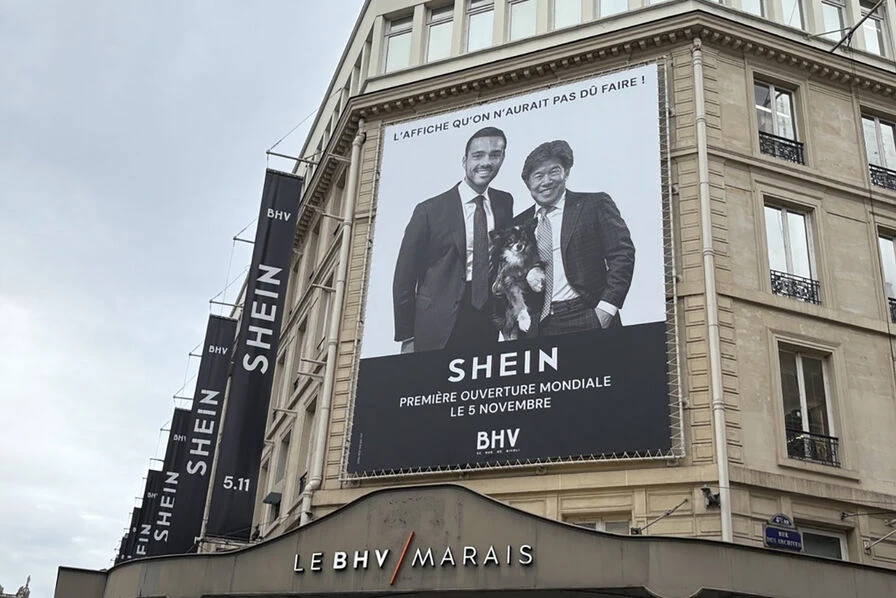
BHV and SHEIN: anatomy of a controversial choice
When the iconic Parisian department store welcomed the Chinese ultra fast-fashion giant, controversy erupted. But behind the backlash lies an economic calculation that reveals much about the transformation of traditional retail.

The traffic crisis
Department stores face an unforgiving reality: footfall is in free fall. According to several industry reports, most have recorded losses between 15% and 30% since 2019, depending on the market. BHV Marais is no exception to this structural decline.
The challenge for the retailer is clear: maintain enough visitors to justify eye-watering rents, attract younger customers to replace an aging base, and create moments that drive footfall in an urban retail landscape now dominated by brand flagships, digitally native retailers, and independent concept stores.
SHEIN is one of the few global players that can guarantee massive crowds. In London, Milan, and Madrid, its pop-ups have generated queues stretching hundreds of meters. For a struggling department store, it's instant oxygen.
An offer too good to refuse
SHEIN doesn't negotiate like a traditional brand. The Chinese giant has enormous financial firepower, an aggressive bricks-and-mortar expansion strategy, and a global marketing budget estimated at over a billion dollars annually.
When SHEIN comes to the table, there's rarely any haggling over tight budgets or compromises: the company pays upfront, secures the space, absorbs the costs, and offers guarantees few others can match. For a Parisian department store scrambling for profitability, this kind of partner is nearly impossible to turn down.
BHV essentially chose between an immediate cash injection on one hand and long-term brand damage on the other. When you're financially vulnerable, most take the money.
Department stores aren't really department stores anymore
For a decade now, these retail institutions haven't lived off sales alone. Their business model increasingly relies on space rentals, rotating concessions, and short-term event partnerships.
BHV, like many others, has essentially become a vertical shopping mall where every square meter, every floor must pay its way. In this model, editorial identity often comes second to financial performance.
Hosting SHEIN ticks several boxes: plug a revenue gap, experiment with new retail formats, and advance a broader business model transformation.
The backlash was built into the plan
Contrary to popular belief, BHV didn't misjudge the controversy. They factored it in.
The marketing and legal teams knew perfectly well that SHEIN is polarizing, that media coverage of its physical ventures is automatic, and that social media would react immediately and loudly. But in modern retail, controversy isn't always a deal-breaker. It can be a visibility tool, even if negative, a way to inject BHV back into the cultural conversation, and a means of reaching audiences who've stopped paying attention to department stores altogether.
This was a cold calculation, not a mistake.
SHEIN is more than just cheap fashion
SHEIN isn't simply a purveyor of throwaway clothing. It's the most sophisticated algorithmic retail operation on the planet, capable of moving from design to delivery in under seven days, and constantly adjusting production in real time based on consumer behavior online.
For a department store, hosting SHEIN also means getting an inside look at a model that's disrupting the entire industry, studying lightning-fast product turnover mechanics, testing how ultra fast-fashion performs in physical retail, and observing how young consumers interact with a digital brand made tangible.
In other words: it's also an education.
The gamble may not pay off
Looking at the risk-reward equation, BHV gained a traffic spike and a lucrative short-term rental. But it sacrificed brand equity, editorial coherence, sustainability credentials, and appeal to premium brands that care about the company they keep.
For a heritage retailer, brand consistency matters. SHEIN creates a narrative whiplash that could take months, or years, to repair.
The bottom line: rational, but risky
Welcoming SHEIN wasn't strategic incoherence on BHV's part. It was a rational economic choice in a context of financial pressure, collapsing footfall, and a fundamental reshaping of the department store model.
But it's also a dangerous bet. In a market where value increasingly flows toward trust, consistency, and responsibility, renting out a piece of your identity to a deeply controversial player may ultimately cost more than it delivers.
BHV bought itself a few days of crowds. SHEIN bought itself another stamp of legitimacy in one of Paris's most storied retail spaces, and that's probably where the real power dynamic lies.